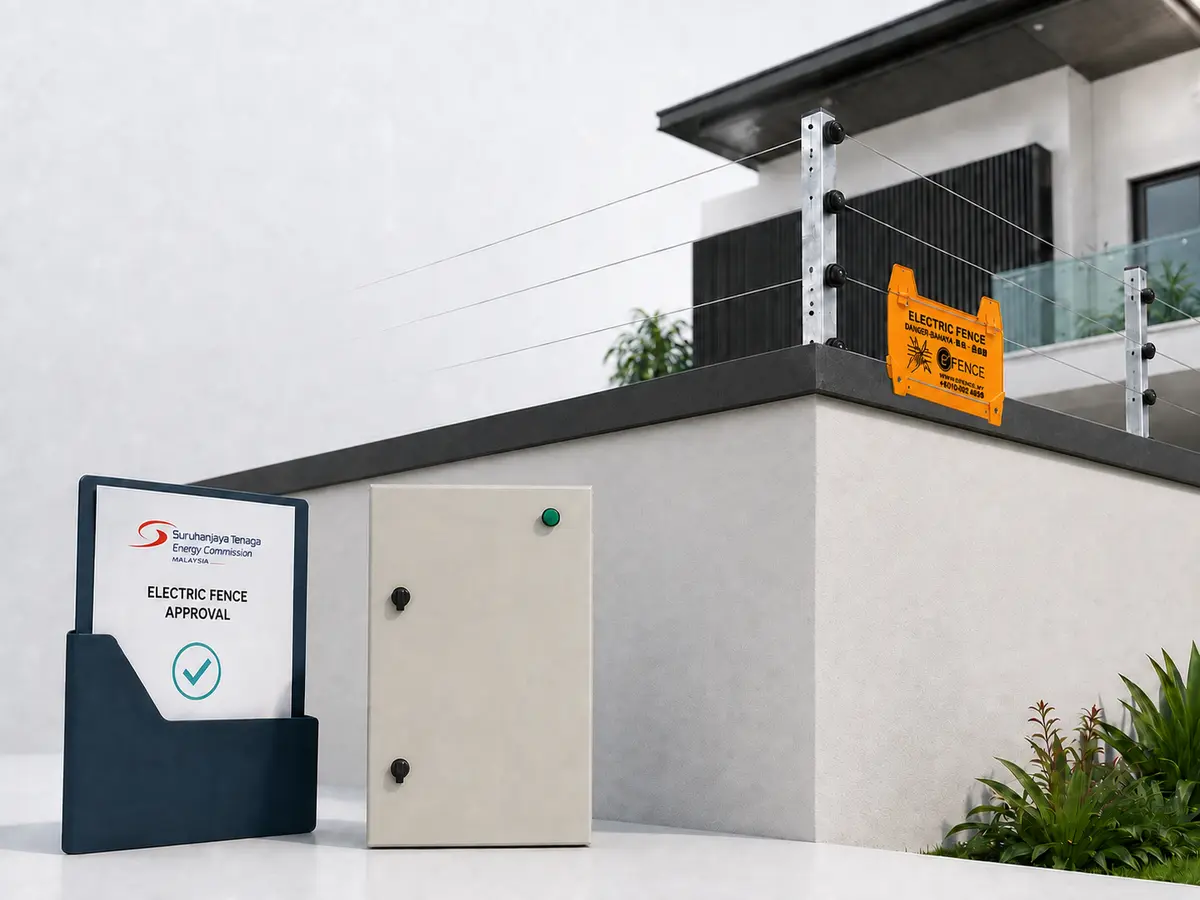

Owner & site
Owner or company details, installation address, purpose, proposed duration and property information.

Suruhanjaya Tenaga states that an electric fence requires written approval to build and written approval to use. The project must follow the required application, installation, testing and inspection process before operation.
The official ST guidance describes two written approvals: approval to build the electric fence and approval to use it after completion and inspection.
Source reviewed 10 August 2026: Suruhanjaya Tenaga electric fence FAQ.
These 3D illustrations explain the process at a glance. They are not official ST diagrams, technical installation instructions or evidence of approval for a particular site.
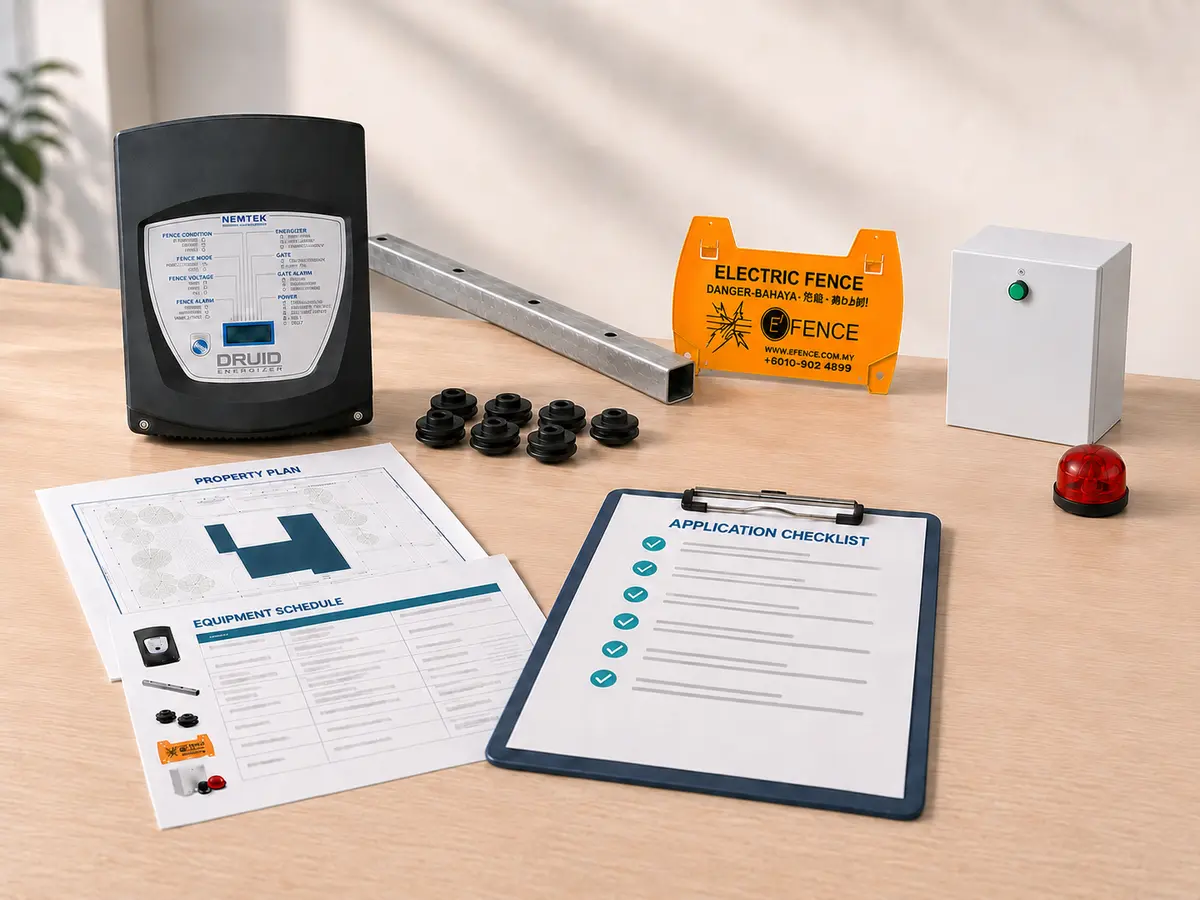
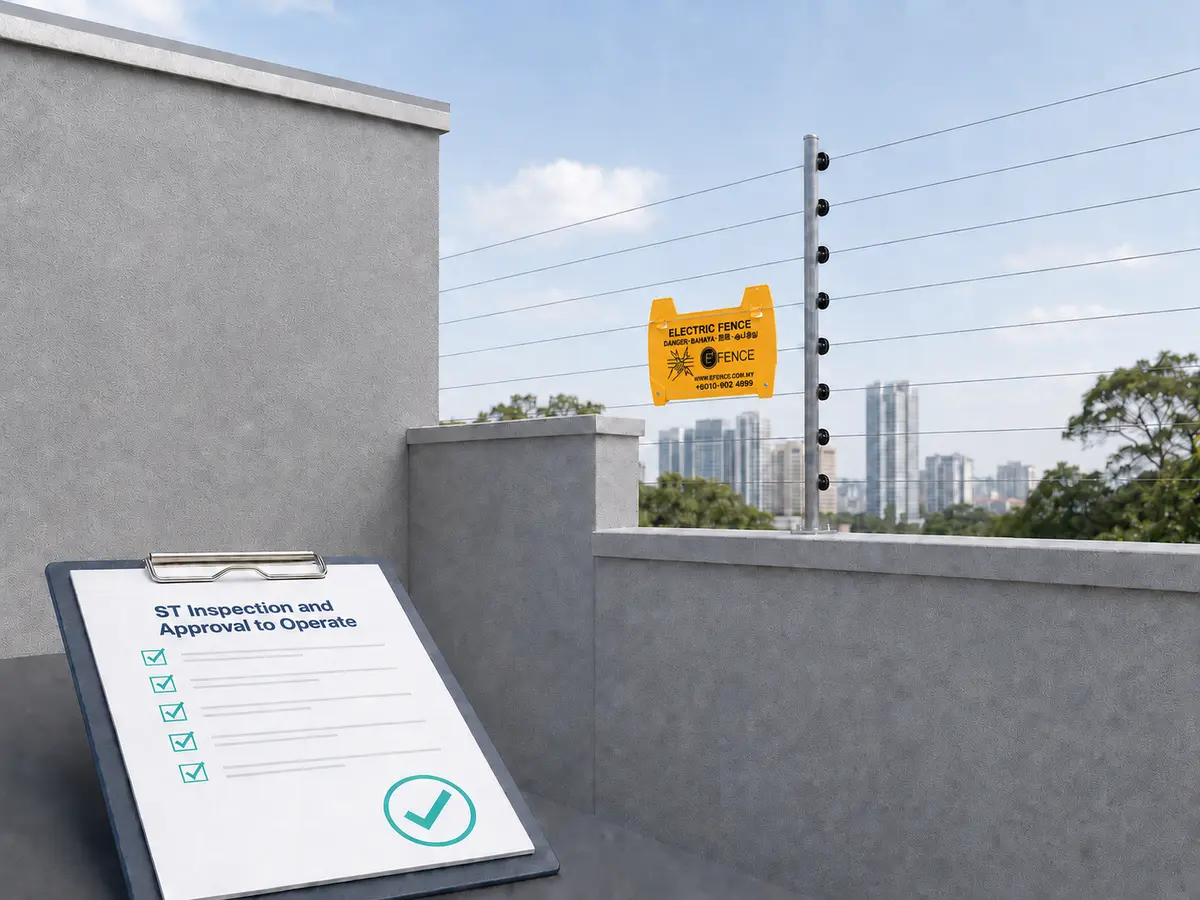
The exact submission and inspection requirements are confirmed for the property and the relevant ST area office.
Confirm the property, intended perimeter, site conditions and quotation information.
Compile owner, site, registered-party, diagram, specification and equipment evidence.
Installation begins only after ST issues written approval to build for the submitted project.
Complete the work, final drawings, supervision records, testing and required statutory forms.
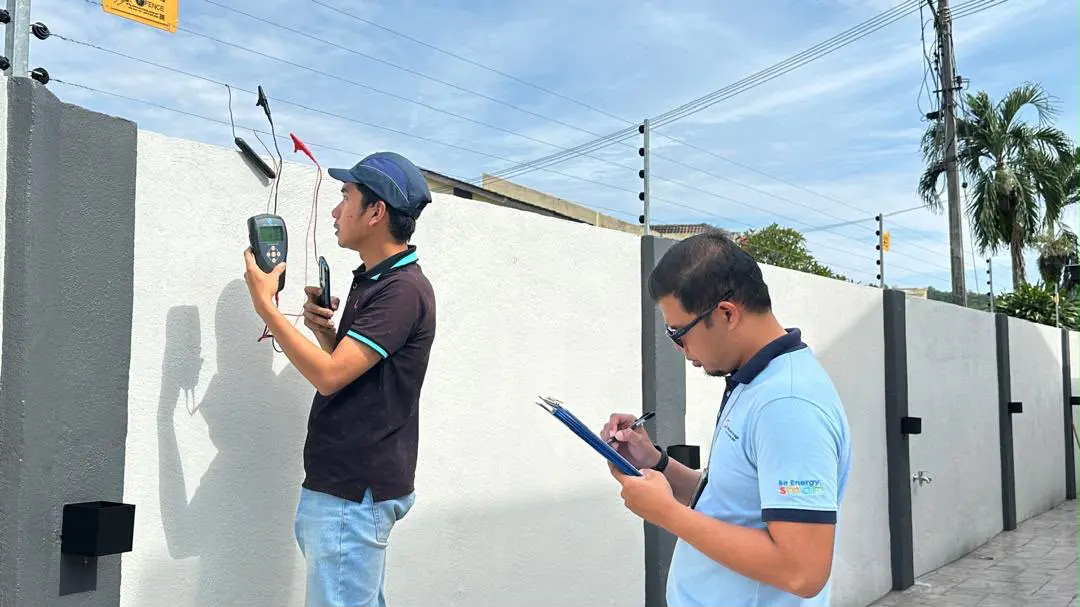
The completed installation is inspected and any required corrections are addressed.
The fence may operate only after the owner receives written approval to use.
The official guide and ECOS workflow identify the following categories. Project-specific requirements can differ.
Owner or company details, installation address, purpose, proposed duration and property information.
Details of the ST-registered electrical contractor and the appropriately registered competent person.
Fence structure, site layout, warning-sign locations and electrical schematics, prepared or endorsed as required.
Applicable certification, test reports and an ST Release Letter where imported equipment requires one.
Required supervision and test documentation, including Forms G and H where applicable.
Consent or approvals from local authorities, utilities, adjacent parties or other relevant bodies when applicable.
Phidea does not present itself as the regulator or as the professional responsible for statutory electrical endorsements.
Provides accurate owner and site information, grants access, obtains permissions where required and remains responsible for ongoing safety.
Supports site assessment, quotation, perimeter planning, document coordination and customer communication for the proposed project.
Carry out or supervise the regulated electrical work and prepare, sign, test, inspect or endorse documents within their registered responsibilities.
Reviews the application, inspects the completed installation and issues the relevant written approval when requirements are satisfied.
The ST guide states that the owner should appoint a competent person of at least Electrical Supervisor level to inspect the installation at least once every two years, with the report submitted promptly to the relevant ST area office.
This periodic inspection is separate from ordinary maintenance or a service visit.
These answers summarise public ST guidance and do not replace project-specific instructions from ST or the appointed competent person.
Yes. Suruhanjaya Tenaga states that an electric fence requires written approval to build and written approval to use. The application is made through the ECOS system.
No. The system should only begin operating after the installation is completed, the required testing and inspection are carried out, and written Approval to Operate is obtained from the relevant Suruhanjaya Tenaga area office.
Typical items include owner and site details, registered contractor and competent-person details, structural diagrams and specifications, site and electrical schematics, energizer certification or test evidence, and other permissions where applicable. The exact list is confirmed for the project.
The relevant drawings, supervision, testing and statutory forms must be prepared, signed or endorsed by the appropriately registered electrical contractor and competent person according to Suruhanjaya Tenaga requirements.
The installation owner remains responsible for ongoing safety. Suruhanjaya Tenaga guidance states that the electric fence installation is to be inspected by a competent person at least once every two years, with the inspection report submitted to the relevant area office.
Regulatory requirements can change. The official source and the relevant ST area office take precedence over this summary.
Content last reviewed: 10 August 2026.Share the property location and a brief outline of the electric fence project you are considering.